Top 5 Functional Fitness Exercise along with Benefits
Functional fitness exercises are very important as it helps to enhance your ability to perform your daily task with greater efficiency and even though reducing the risk of injury functional fitness helps you to improve your strength flexibility coordination and balance and help you ultimately towards a better quality of life so today let’s see the top five functional fitness exercises which you can perform to improve your fitness level and even the benefits you get from these exercise.
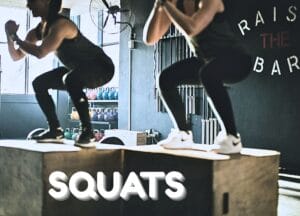
1) Squats
- Squats is one of the exercise which involves your whole lower body movements. While performing squats the muscles which are involved in this exercise are quadriceps which are known as front thighs, gluteus maximus (buttoks), hamstrings (back thighs), calvesand lower back.
- Benefits
- Let’s see the benefits you get from performing this squats.
- It helps to build your lower body strength.
- It helps to announce your core stability.
- It improves your mobility and flexibility.
- It helps to burn calories and Boost Your metabolism.
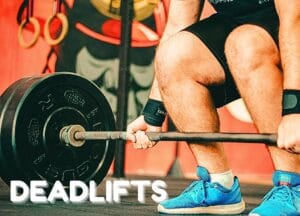
2) Deadlifts
- Deadlifts is one of the most known workout or fitness exercise which involves both primary and secondary muscles in primary muscles it involves and erector spine the lower back, quadriceps and trapezius, while secondary muscle involves forearms, Core and lats.
- Benefits
- Benefits of deadlifts are it helps to strengthening your whole body.
- It enhances your grip strength.
- Boost Your core stability.
- It improves your bone density.
- It increases your hormonal output.
The Common Mistakes to Avoid
- Letting the bar drift away from the body
- Rounding the lower back
- Hyperextending the back at the top
- Pulling with arms instead of legs and hips
- Not bracing the core before the lift
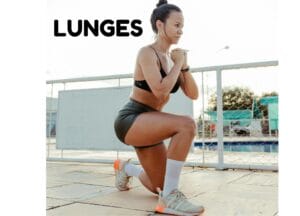
3) Lunges
- Lunges are one of the exercise which helps you to stabilize your lower body. It include the both primary and secondary muscles
- Benefits
- Lunges helps you to enhance balance and coordination.
- It Boost Your core engagement.
- improves your hip mobility.
The Common Mistakes to Avoid
- Letting the front knee collapse inward
- Stepping too short or too far forward
- Letting the heel of the front foot rise
- Rushing the movement—control is key
- Leaning the torso too far forward
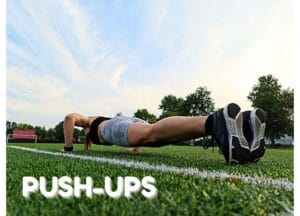
4) Push-ups
- One of the most common functional fitness exercise performed by each and every athlete known as push up, a major body part include triceps, deltoids, pectorial, triceps, lower back glutes and quads.
- Benefits:
- It helps to build your upper body strength.
- It’s strengthens Core and stability.
- It improves your functional movement.
- It also helps to enhance joint support.
- It Boost Your endurance and cardio.
Push-Up Progression Plan Example:
| Week | Variation | Sets × Reps |
|---|---|---|
| 1–2 | Incline Push-Up | 3 × 10 |
| 3–4 | Knee Push-Up | 3 × 10–15 |
| 5–6 | Standard Push-Up | 3 × 8 |
| 7+ | Add Tempo or Elevation | 3–4 × 10–12 |
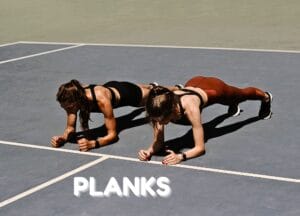
5) Plank
Plank is one of the exercise which majorly focuses on your abdominal muscles while performing planks the muscles involved are oblique muscles, rectus abdominis, transverse abdominis.
- Benefits.:
- Plank’s helps you to build deep core strength.
- It improves your posture.
- It improves your balance and coordination.
- It reduces the risk of injuries.
- It Boost Your athletic performance and improves your overall flexibility.
Plank Variations
| Variation | Description | Focus |
|---|---|---|
| High Plank (Straight-Arm) | Hands under shoulders like a push-up | More shoulder/chest activation |
| Side Plank | One arm/leg on the side | Obliques, glute medius |
| Plank with Leg Lift | Lift one leg slightly | Glutes, balance |
| Plank with Shoulder Tap | Tap shoulders alternately | Anti-rotation core strength |
| Plank to Push-Up | Transition between low and high | Dynamic stability |
| Weighted Plank | Add plate to back | Increased resistance |
Common Mistakes to Avoid
- Sagging hips – puts pressure on lower back
- Butt too high – reduces core engagement
- Looking forward – strains neck
- Holding breath – reduces oxygen supply to muscles
- Collapsing shoulders – causes poor support